I left school that Friday afternoon carrying a sewing machine.
I had snuck into the Home Economics room on the last day of class before Christmas vacation. The hallways were quiet and dark.
I felt a surge of excitement when I saw the long line of machines. I had been in Nunavut for more than a year and I didn’t have a traditional parka. I was determined to sew one.
When I noticed that each machine had a handle, I decided I didn’t need to ask permission to borrow one. I wasn’t afraid the principal would say no. I was more afraid that he would ask me what I was planning to do with it.
I didn’t tell anyone about my project, except the one person who held the prized pattern that I would use to create my new parka.
In most northern communities, there were only a few parka patterns — large pieces, made of white paper, sometimes wrinkled and weathered — passed from one woman to another.
I was grateful when Regilee, the Home Economics teacher, and an Inuk, let me borrow her pattern, as long as I returned it. She was handing it over to a qallunaat (kha-loo-naht) – the Inuktitut word for white person.
I was intrigued by that word when I first learned what it meant, and that it referred to someone like me in this community of 1,300 mostly Inuit Canadians called Mittimatalik (meet-i-mat-aa-lik), or Pond Inlet.
The weight of the sewing machine in my hand slowed me down as my legs trudged through the snow. That day, there had been a mere sliver of light along the horizon at noon. It was the season of twenty-four-hour darkness. I was spending more time inside. I hoped my sewing project would help me pass the time and that it might prove to my mother, a seamstress her whole life, that my decision to come to this place was not the wrong one.
I had never seen her as angry as they day when I told her I had decided to move here.
“Why do you want to go there?!” she screamed. “There isn’t even God up there.”
In fact, “God” had come north, even to the third most northern community in all of Canada. There were two churches in Pond: a Catholic and an Anglican. When I told my family I wasn’t going home for the holidays, my mother took solace in knowing that at least I could go to church on Christmas Day.
The walk from the school to my house felt longer than a few minutes. It had been a difficult four months. The novelty of my first year of teaching in Pond — tasting seal meat for the first time; learning Inuktitut; teaching my Grade 8 students knock-knock jokes; sliding down an iceberg; seeing majestic glaciers from my window – had been pushed out by the scenes of students who challenged my authority and told me to go back to where I came from and the tensions among Inuit and quallunat (kha-loo-naht) staff in the face of a string of suicides among the youth that felt like a wild fire that we just couldn’t contain or extinguish. I had come to the north as a teacher to help make a difference, and I was beginning to feel that I might be part of the problem.
But as I walked up the steps to my home, I was buoyed by my goal of sewing a parka. I wanted it to be a small symbol that I was not completely “other.”
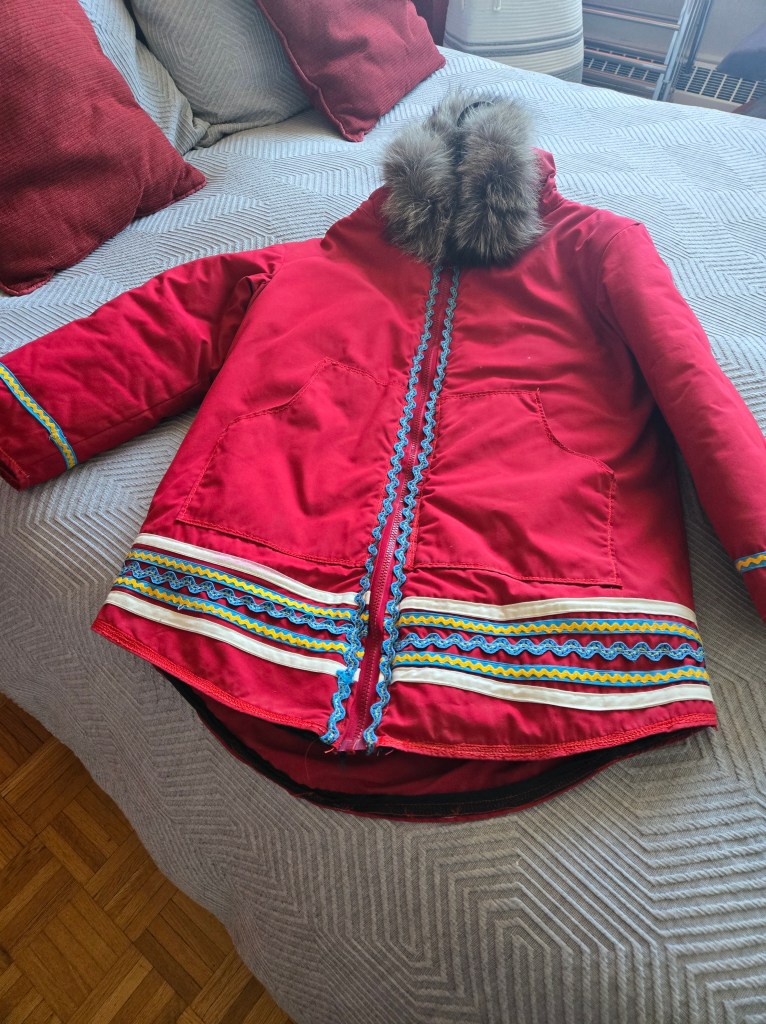
I had chosen a fire-engine red cotton material for the outer shell. And the woman who sold material in town suggested white, yellow and baby-blue ribbon for the embellishments. I laid the material out on the living room floor. I unclipped the pattern pieces and was delighted to see the words “front” and “back” and “sleeve”.
I worked well into the early morning, pinning, cutting, and sewing the pieces together. The hum of the sewing machine as the red thread pierced the fabric made me not want to stop.
Time stood still for two days. I would get up from bed and sew in my pyjamas. When I finished the red outer layer, I worked on the quilted inside, which was more challenging. When the thickness of the material was too much for the machine, right around the sleeve openings, I did what I often saw my mother do and sewed by hand. The stitches were uneven, but I consoled myself by saying at least they matched some of the messy inside seams. I could hear my mother’s voice, “It’s nice, but let me look at those seams.”
Then came the invitation on Sunday evening to attend a community gathering at the school. I had just finished sewing the red zipper that connected the outer coat to the inner lining. The parka was almost finished! The only thing that was missing was the fur for the hood.
As I walked into that gymnasium wearing my parka, I felt a nervous anticipation. I was proud of my parka, but I kept thinking to myself: I don’t want anyone to look at my seams. My mother would be amused.
I exchanged knowing glances with some community members. Then, a woman I didn’t know approached me, and said, “I like your parka. Did you make that?”
“Yes, I did.”
“You did a great job. I love the colour,” she said, leaning in for a closer look.
“Well…it’s okay,” I said. “Just don’t look on the inside.”


 A Writing Journey
Leave a reply to Sarah Valter Cancel reply