I was on the subway heading home when something bright caught my eye.
It was a poster, across the aisle, of a surfer. (We are in the final days of March and a very long winter season is still lingering in Toronto, with wind chill in the minus digits. Spring, while officially here, has definitely not sprung.) The image of a surfer engulfed in a massive wave and the contrast of the white spume against the deep blue waters captured my attention — or maybe my envy.
My eyes followed the crest of the wave, which led to these words in bright pink capital letters: “WAVE SEEKER”. It seemed to call my name, even if I had never sought out a wave like that in my life.
The subway poster now had my full attention. Given the distance, I was straining to read the fine print.
This is when I decided to use a trick I had seen my Gen-Z niece (a digital native) use in this same situation. I got out my phone and zoomed in. The result: the photo below. Sufficient to capture the moment. Discrete enough that I didn’t attract the ire of the man sitting just in front of said poster. One quick click and my phone was back in my lap. (Success, I thought. Now I definitely have a slice for tomorrow!)
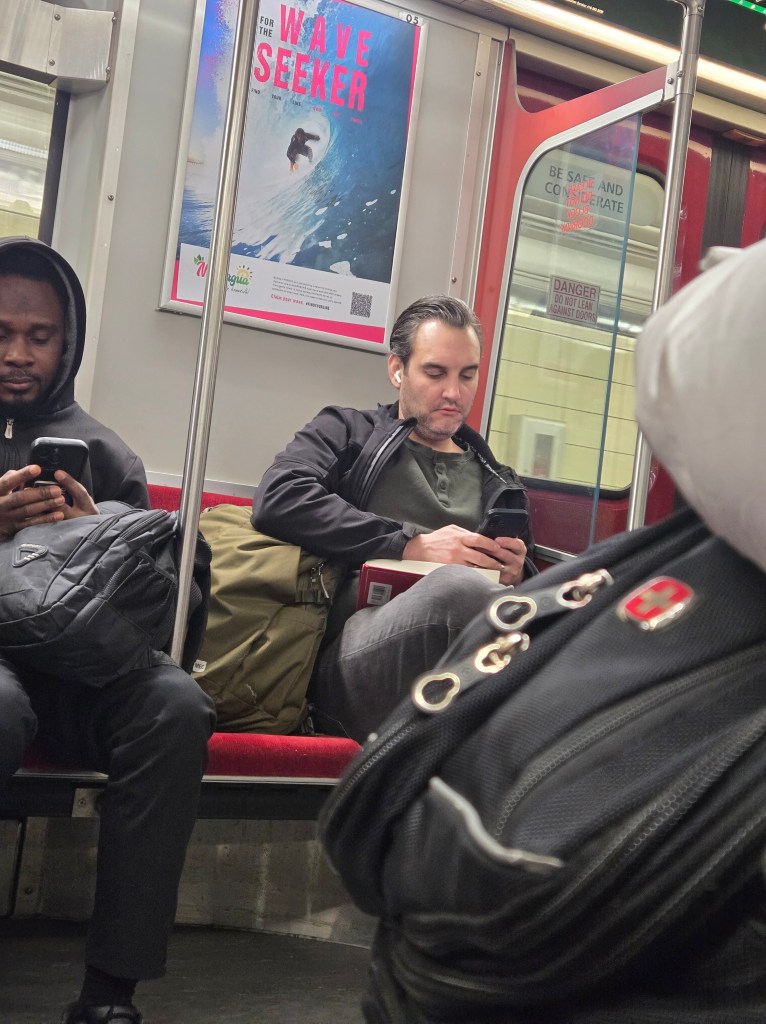
With the photo secured, I zoomed in. That’s when the most fascinating fact revealed itself. In the lower lefthand corner: Nicaragua.
Nicaragua, I thought. That’s where this guy is catching that wave. Emphasis on “this” and “that”.
My Gen-Z niece had taught me another trick. When in doubt, google it. So, lucky for me Toronto Transit now has wifi access on trains, so I checked.
Google search: Nicaragua, surfing
Result: Nicaragua is a premier surfing destination featuring over 300 days of offshore winds annually, thanks to Lake Nicaragua, with peak swells from March to November. The Rivas province, particularly near San Juan del Sur and Popoyo, offers consistent, warm-water breaks ranging from beginner-friendly beach breaks to high-performance reef breaks.
And this image (which now looks very familiar to me) was featured:
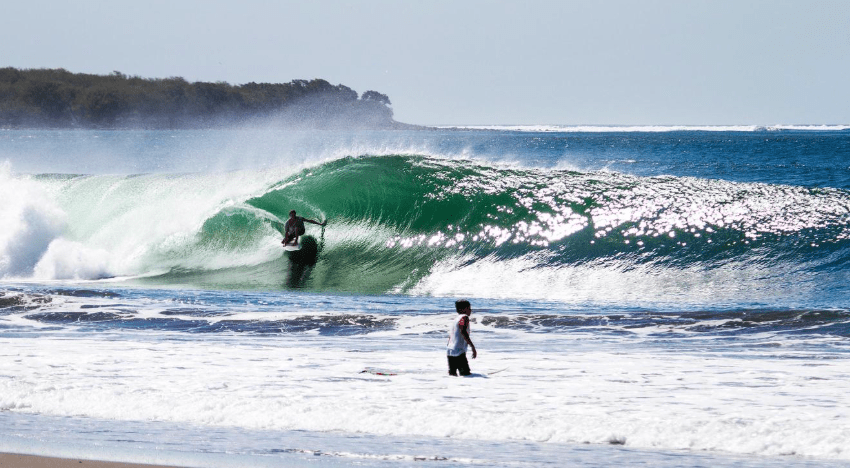
Premier surfing destination. Peak swells. March. Warm-water. Beginner-friendly. These words just jumped off the screen like they were screaming at me.
So, there I had it. Proof. Nicaragua was a surfing destination. Nicaragua was a tourist destination. Nicaragua was being remade right in front of my eyes.
Speaking of eyes, I was still squinting at the poster. Trying to read the remaining text. Remembering the photo I discreetly captured on my phone, I opened it and zoomed in again, as close as I could. The fine print: FIND YOUR LINE. OWN THE SWELL.
Sounded like code to me. What does that mean? Clearly, I had no idea Nicaragua was the premier surfing destination, and I had no clue how to speak “surfer” either.
Google to the rescue. Did I mention how convenient it is that wifi works underground?
Results: Finding “your line” in surfing refers to identifying the optimal path, angle, and position on a wave to generate speed and maximize ride time. It involves a combination of reading the wave, positioning in the lineup, and angling your takeoff.
“Own the swell” in surfing means having the skill, knowledge, and confidence to fully utilize a specific, high-quality wave-generating storm event (a “swell”) to catch the best possible waves at a particular break. It implies that a surfer can read the swell forecast, understand how the wave direction and period will interact with local geography, and dominate the lineup to get the best rides during that period.
Just like that, my surfing education swelled well beyond my imagination. With my subway stop fast approaching, I took one more look at that poster. Then down at the image on my phone. Zoomed in again to the bright pink letters that graced the bottom of the poster: “Claim your wave.”
I take that to mean there’s a wave in Nicaragua with my name on it. And, mark my words, if spring doesn’t arrive in Toronto soon, I may just have to go down there and “find my line!” Or is it “own my swell”?


 A Writing Journey
Leave a reply to Melanie Meehan Cancel reply